Adam Savage Goes Inside ILM to See How the New Razor Crest Miniatures Were Filmed
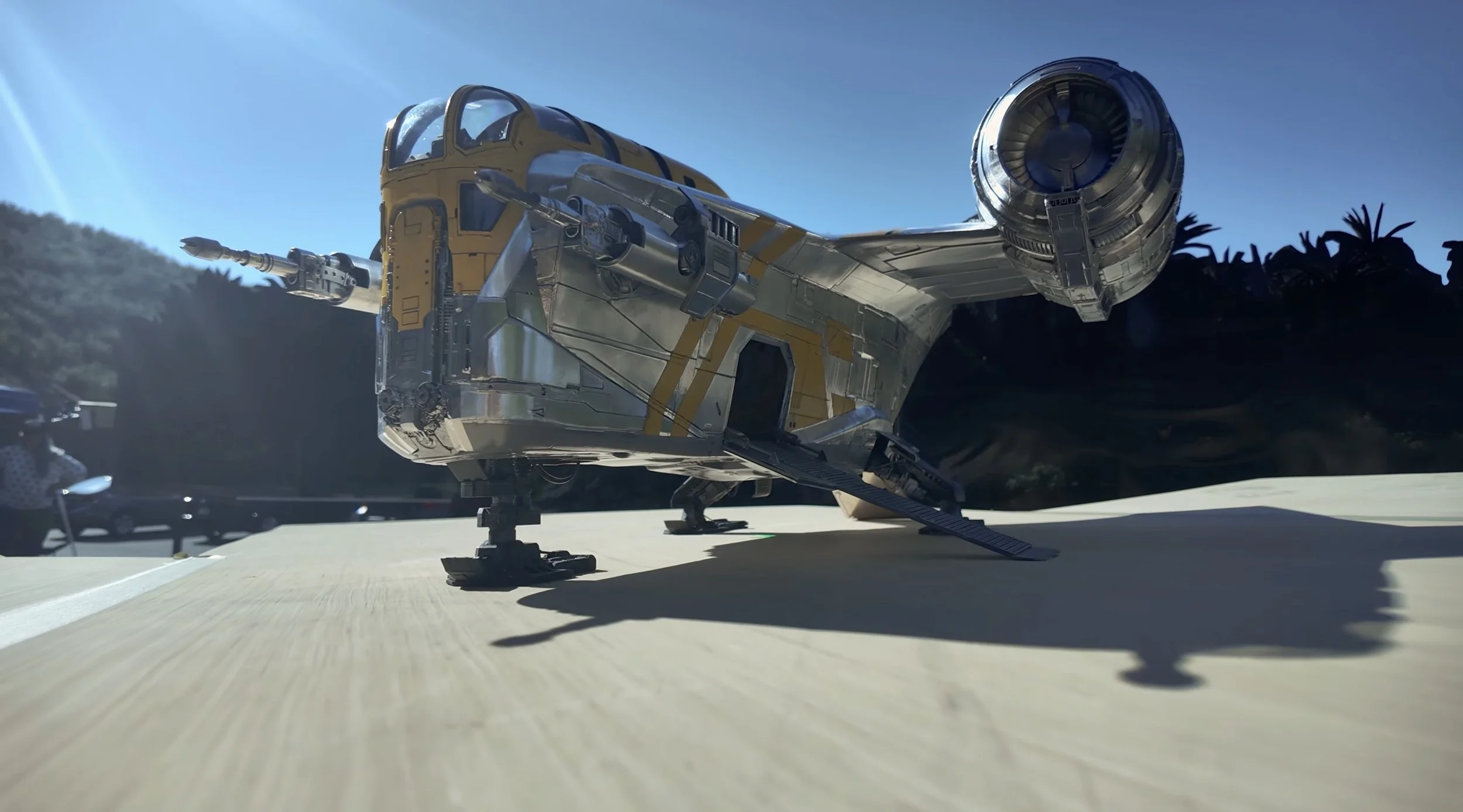
In a recent Tested video, Adam Savage visits ILM to see how the completed Razor Crest models are being filmed for the production. The tour includes ILM’s upgraded motion-control stage, a custom miniature LED volume, compositing techniques, and an outdoor shoot at Skywalker Ranch where the larger Razor Crest gets photographed under real sunlight.
There’s even an appearance from Jon Favreau, who clearly shares Savage’s enthusiasm for seeing an actual Star Wars spaceship sitting outside in the California sun.
A major part of the video centers on John Knoll and the new motion-control rig he developed after working with a much simpler system in the past. Knoll wanted smoother track movement, additional degrees of freedom, and a proper crane, so he built exactly that.
The new system uses standard Matthews camera dolly track, while much of the remaining hardware is custom-built from extruded aluminum and other components. One of Knoll’s biggest engineering priorities was eliminating backlash from the mechanisms so the camera and model movements could be repeated with extreme accuracy.
That includes a large gear reduction between the stepper motor and sprocket, with multiple timing belts pulled tight enough to virtually eliminate backlash. Ball screws and tightly machined linkages help keep everything repeatable while still allowing the rig itself to flex slightly.
That precision becomes especially important when you see what ILM is putting on the rig. The finished Razor Crest miniature is about four feet long and absolutely loaded with physical detail. It sits on a three-axis model mover capable of controlling roll, pitch, and yaw. The size and weight of the miniature meant Knoll couldn't simply reuse the smaller mover previously employed for a 24-inch model.
His solution came from ILM history. Knoll remembered an old geared camera head that had once been displayed outside the company's PR office. The equipment was still sitting in storage, so it was pulled out and put back to work.
Since the old pan-and-tilt head only provided two axes of movement, Knoll added another custom belt-driven mechanism to give the Razor Crest the movement needed for the shoot.
It’s a great example of ILM combining modern digital filmmaking with hardware that has been hanging around the company for years.
The process of deciding which shots should actually use the physical Razor Crest is equally interesting. Knoll went through the film and identified roughly 30 shots he wanted to attempt with miniatures.
Not every spaceship shot automatically benefits from using a model. A fast-moving shot buried in motion blur might make more sense as CG. Knoll is interested in shots where audiences can really see the ship and where the physical miniature's handcrafted qualities can contribute something worthwhile to the final image.
ILM can design those shots digitally before anything moves on the physical stage. A CG version of the motion-control rig can be created with animators limited to the same motorized axes available on the real hardware. That means they can design a shot while already accounting for the physical limitations of the camera and model movers, including possible collisions and clearance problems.
One of the trickier parts of photographing the Razor Crest is its reflective metallic surface. For earlier miniature work on The Mandalorian, Knoll could concentrate largely on space shots, where lighting could be created with a primary light source and strategically placed bounce cards.
Once the Razor Crest enters an atmospheric environment, things get much more complicated. Its reflective body picks up the sky, horizon, landscape, and surrounding light.
ILM's answer is basically a miniature version of the LED volume technology associated with modern Star Wars production.
The team built an approximately eight-foot-by-eight-foot-by-eight-foot, four-sided LED cube around the model. Environment artists create imagery that can be displayed across those LED surfaces, providing both illumination and reflections on the Razor Crest.
Instead of trying to fake every reflection with conventional studio lights, the ship can reflect the environment it’s supposed to be flying through.
That also gives the miniature some gorgeous subtle detail when photographed. Knoll explains that the LED volume can produce so much light that they sometimes have to turn it down, even while shooting at ISO 100 and F/22 with exposures around 1.3 seconds.
The team also photographs different lighting elements separately for compositing. Running lights, sunlight and other passes can be captured individually, allowing artists to adjust their intensity and timing later. Knoll shows Savage an early composite where sunlight can effectively be brought on and off because it exists as its own image stream.
The LED panels create another technical problem, though. Because each LED is a tiny illuminated point surrounded by a black matrix, the model can develop jagged edges when photographed directly against the panels.
The solution is wonderfully practical. A black area is positioned on the LED wall directly behind the Razor Crest from the camera's perspective. Most of the volume can continue illuminating and reflecting across the model while the camera sees a clean black background immediately around its silhouette.
Then the production heads outside. At Skywalker Ranch, the larger Razor Crest is photographed using actual sunlight, and this is where Favreau joins Savage to admire the finished miniature.
Favreau points out how well the ship's physical metal treatment reacts to harsh natural light. The model uses foil and other physical surface treatments that create complicated specular highlights, reflections, hot spots and imperfections. Even the canopy contains tiny scratches that contribute to the image as the camera gets closer.
CG remains a huge part of the filmmaking process, something Favreau readily acknowledges, but the physical model provides details generated naturally by real materials interacting with real light.
Of course, shooting outside introduces one gigantic light source that ILM can't move: the sun. Knoll plans the outdoor photography around its position throughout the day. He uses sun-position calculations and time-of-day studies to determine the best orientation for the Razor Crest and the ideal shooting window for each planned shot.
The miniature, camera track and individual camera positions are carefully arranged so multiple shots can be captured without constantly rebuilding or realigning everything. The crew spends the morning testing moves against the previs, then shoots each planned move as the sun reaches the required position.
That turns the outdoor miniature shoot into a race against natural light. On the ILM stage, the crew can control practically everything. At Skywalker Ranch, they have to work with whatever nature gives them.
For Savage, seeing a real Star Wars model sitting outside at the Ranch understandably brings out the kid in him.
Favreau also takes a moment to praise Savage for digging into this side of filmmaking and recognizing the enormous amount of work craftspeople put into details audiences may never consciously notice.
The whole Tested video is a fantastic look at what makes ILM's approach so much fun. This isn't practical effects fighting against CG or some attempt to prove one technique is better than another. It’s physical miniatures, digital previs, motion-control photography, LED environments and compositing all being used together to get the shot.
Most importantly, ILM built a four-foot Razor Crest, put it on a giant motion-control rig, hauled it out into real sunlight, and filmed it like a proper Star Wars miniature.
That’s just awesome.