AI-Generated THE ODYSSEY Movie Trailer Released Just as Christopher Nolan’s Version Hits Theaters, and
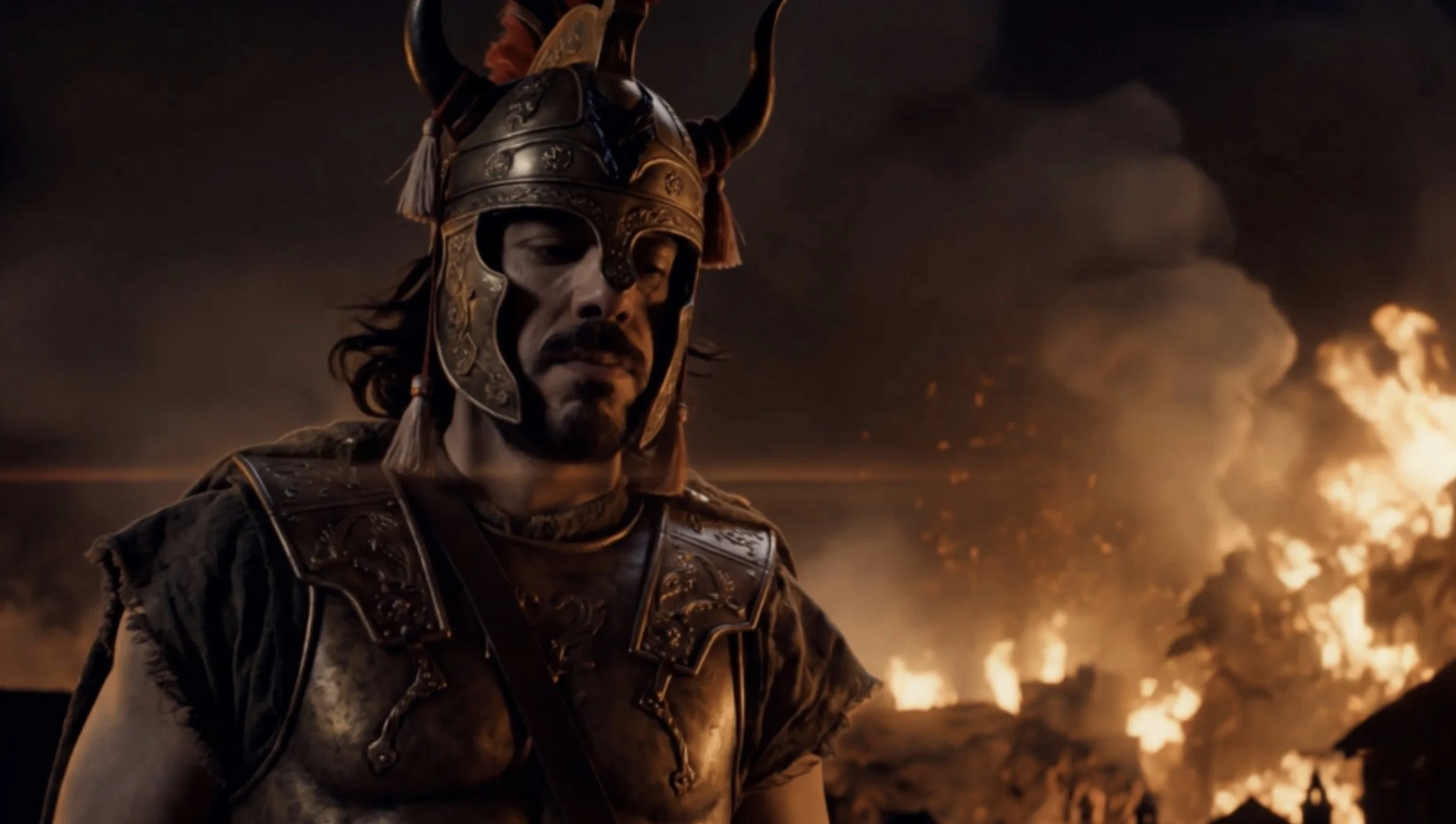
Just when you thought the conversation around The Odyssey couldn't get any louder, another adaptation has entered the arena. Only this one wasn't shot with cameras, built with elaborate sets, or packed with A-list stars. It was generated with AI, and the first trailer has been released.
If you've been keeping score, audiences now have Christopher Nolan's The Odyssey landing in theaters, an AI-generated audiobook of Homer's epic narrated by Michael Caine, The Asylum has their take, and now a feature-length AI movie called Odysseus: The Fall.
The 135-minute film comes from Ash Koosha, the filmmaker behind Dreams of Violets, the AI-generated docudrama about the recent Iranian protests that premiered at the Tribeca Festival.
While wrapping up Dreams of Violets, Koosha spent the next three months creating his own interpretation of one of mythology's most enduring heroes.
The movie is being released through AI film studio Fountain 0 and will be available to rent or purchase from the company's website later this summer.
Koosha says this wasn't some opportunistic attempt to capitalize on Nolan's film. It's a story that's been with him for most of his life. Ok, sure.
“I’ve been just obsessed with it since I was a kid. One of the things that really drove me towards this story was the character of Odysseus himself, and my take on it — the feeling that I’ve had over the years reading different takes on it, and different translations — and my take was something that I just wanted to tell. And recently, when we did the first film, I realized this is the best time given the public discourse that exists out there as well.”
Of course, the timing is impossible to ignore. Fountain 0 announced the project as excitement surrounding Nolan's epic reached a fever pitch. Whether intentional marketing or coincidence, people are inevitably going to compare the two films despite them having almost nothing in common outside of the source material.
Fountain 0 sees AI filmmaking as a way for creators to produce movies much faster and at a fraction of the cost, allowing filmmakers to jump into current cultural conversations instead of spending years trying to get financing and waiting for release dates.
Tom Rogers, Fountain 0's executive chairman and an executive producer on Odysseus: The Fall, explained: “We tried with ‘Dreams’ to very much show that an AI-generated film was able to create something … at the speed of news.
“To be able to produce something at speed that allows you to contribute to it — in this case, Ash’s personal view of Homer and his personal desire to be able to do something on a piece of literature that he has felt very, very close to for a long time — gives us, gives everybody a sense that you can participate in creating film with speed in a way that it really contributes to it.”
Whether audiences actually want movies created "at the speed of news" is another conversation entirely. Sometimes it's worth taking years to make something great. Then again, the technology isn't waiting around for anyone's approval.
Instead of a traditional screenplay, Koosha worked from notes while using the AI video generator Kling to build the movie. Because of that workflow, he says the film remained flexible throughout production.
“We’re in post production right now. Still, the script is open to interpretation. Why? Because the risks don’t exist.”
That's certainly one way to approach filmmaking. Traditional productions and smart filmmakers spend months locking scripts before cameras roll. AI projects apparently keep rewriting themselves almost until release. Whether that's liberating or a recipe for creative chaos probably depends on who's sitting in the director's chair.
Compared to Dreams of Violets, Odysseus: The Fall also received a larger budget, which Koosha says landed in the mid-five figures. The film also aims for a much bigger visual scale, leaning into blockbuster spectacle rather than intimate drama.
One of the more fascinating aspects of the production is how it handled its cast. Rather than generating entirely fictional people, the filmmakers licensed the likenesses of 12 real individuals, including one professional actress, several models, people with no entertainment background, and Rogers himself. Koosha even used his own likeness as the template for Odysseus.
Those likeness licenses apply only to Odysseus: The Fall, although participants can choose to have their digital models added to a catalog for future AI productions. Instead of receiving traditional acting salaries, they're compensated through backend profits generated by the film.
Koosha says directing AI versions of people actually works better when he personally knows them, while Rogers believes directing an AI likeness can sometimes be easier than directing the real person.
“In the case of somebody like me, with zero acting experience, it’s infinitely easier for Ash to direct me through my image and a model than it would be to direct me live in any kind of context where, not having any acting experience, I’d be pretty hard to direct.
“With an experienced actor, that might look very different, but here’s a way to incorporate image in a way that image can be used without the difficulties of directing when somebody is not able to really perform at the level that you’d want in a major movie.”
That's a statement that's bound to raise eyebrows among actors. Hollywood has already spent years wrestling with AI and digital likeness rights, so hearing someone suggest AI performers might actually be easier to direct probably won't calm anyone's nerves.
To Rogers' credit, though, he isn't pretending this movie is going toe-to-toe with Nolan's production. “I don’t think anybody is going to think this film is better than Nolan’s film.” That's probably the most grounded comment in this entire discussion.
Instead, he sees the project as proof of what AI filmmaking is capable of today and hopes audiences use it as a measuring stick for where the technology currently stands.
“There will be a lot of people who either are not interested in the Odyssey, or they don’t like going to the movie theaters, but have a real interest in AI and what’s going on.
“And we actually think, when our film is released, that it will be a catalyst for a lot of people who might not otherwise have seen the Odyssey to hopefully go see it, so they can compare the state of the highest state of human filmmaking achievement, which I truly expect the reviews to suggest Nolan’s film is, with what the top state of the art is in AI filmmaking today.”
That's an interesting way to frame it. Rather than positioning AI as a replacement, Rogers is inviting audiences to compare where traditional filmmaking currently stands versus what artificial intelligence can accomplish right now.
Koosha also hopes people eventually stop treating AI filmmaking like it's some separate category altogether. “I don’t think it’s a question of putting traditional film versus AI film.
“They are not different together because there is a lot of economic outcry, political division, and people assign things to what they don’t like or what they like, and a lot of people don’t understand AI.
“So when we move past the point where AI is surrounded with so much discourse, and when we ignore the fact that AI is this sort of alien thing, that whether we should use it or not, then it becomes about the stories.”
Whether you agree with that or not, one thing seems inevitable. AI-generated movies aren't disappearing. The technology is advancing at a ridiculous pace, and filmmakers are going to keep experimenting with it.
Will audiences embrace it? That's the real question. I’m gonna say that most people will not. Hell, who is actually going to pay to watch it?
Personally, I don't think AI is replacing great filmmakers anytime soon. People still connect with the human craftsmanship that goes into a movie made by talented artists, actors, cinematographers, editors, composers, and crews working together.
For now, Odysseus: The Fall feels less like the next great adaptation of Homer's epic and more like a ridiculous snapshot of where AI filmmaking stands today. Whether that's exciting or unsettling probably depends on who's watching. Either way, the conversation isn't ending anytime soon.
Source: Variety