AVATAR: FIRE AND ASH Behind-The-Scene Clip Shows James Cameron Shooting the Film Himself
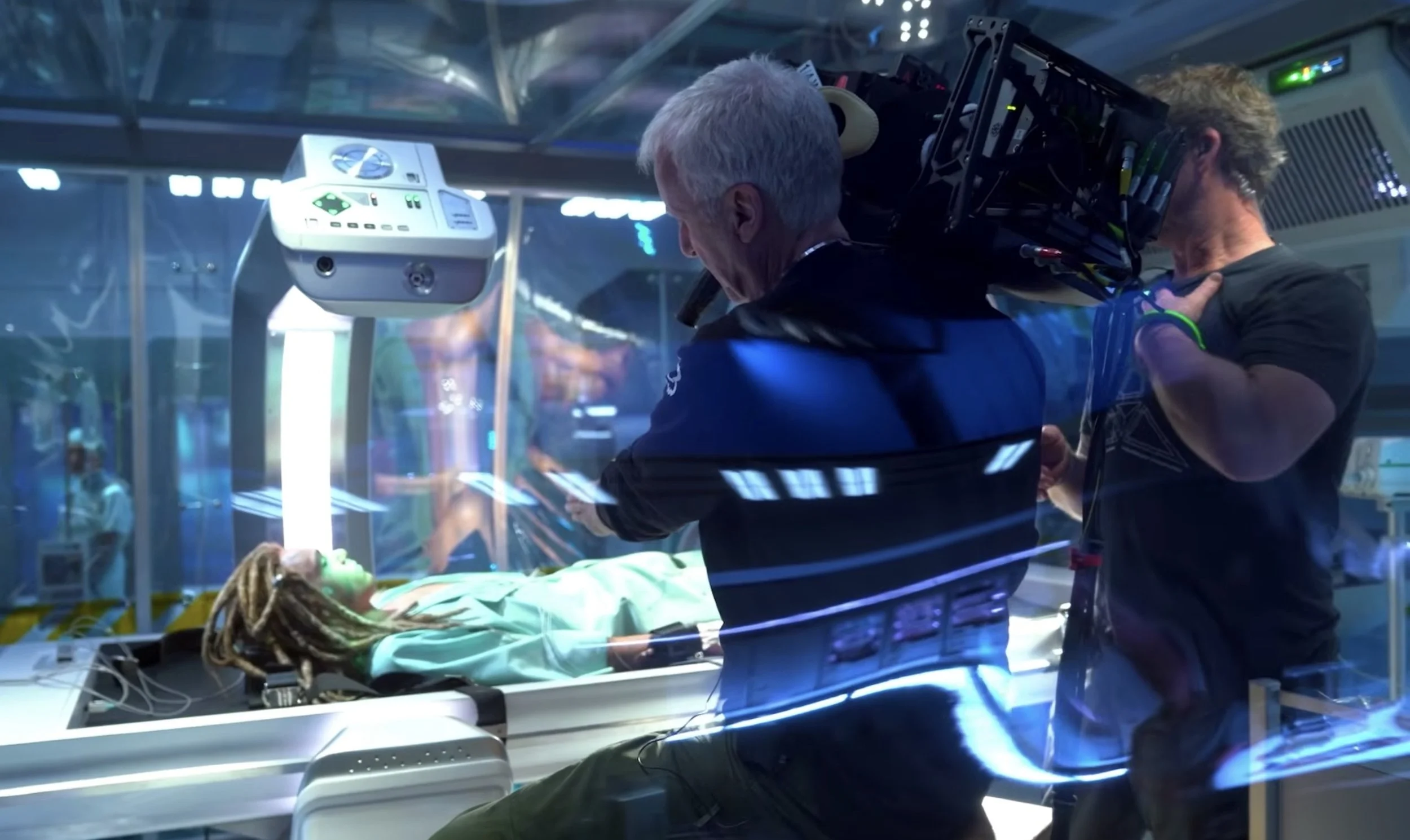
The Avatar: Fire and Ash home release gives fans a front-row seat to one of Hollywood's most obsessive filmmakers doing what he does best.
There are directors, and then there is James Cameron. Most filmmakers are happy enough to sit in the chair, watch the monitors, and let their crew do the technical lifting. Cameron, famously, is not most filmmakers.
The man has written, directed, produced, edited, and co-invented the technology needed to shoot his movies. He has also, as it turns out, operated the camera himself on Avatar: Fire and Ash, and there is footage of it.
A clip from the film's upcoming home release captures Cameron on set completely in control, physically engaged, and doing the job of multiple people at once.
What makes it more interesting is that Cameron isn't just noodling around with a camera for fun. On Fire and Ash, he personally handled around 65% of the virtual camera work, with cinematographer Richie Baneham covering the remaining 35%.
As Cameron himself put it, while talking to postPerspective, "partly because I simply like to operate." postPerspective That's not a director dabbling; that's a director who genuinely can't stay away from the craft.
The production process behind these films is genuinely unlike anything else in the industry. Cameron shoots everything twice and cuts everything twice. First, there's the raw performance capture with the actors over 18 months.
Then he goes back into an empty capture volume and shoots virtual cameras for roughly a year, alone, building the actual shots. postPerspective The editors work behind him in real time, assembling scenes while he shoots, and he'll later go in and do a final pass to reshape the edit. It's a workflow that would exhaust most people. Cameron seems to treat it like a hobby.
The production itself leans harder into practical filmmaking than audiences probably realize. Cameron has described it: "The Tulkuns in the water are water performers from Cirque du Soleil. This movie is shot with practical, in-camera action; it's all real.
“We're sinking a ship for real. When someone flies a bird, we're not animating that; we capture it on a rig. When a character is riding underwater on an Ilu, we built a jet machine that flies underwater with someone piloting it and another person grabbing onto the back of his neck, flying underwater at 20 knots. The stuff that we're doing, you've never seen done practically in a film before." Motion Picture Association
And the technical ambition extends all the way to the hardware itself. Cameron's dictate to cinematographer Russell Carpenter was that the camera system had to weigh less than the one used on the original Avatar.
Sony spent years developing a camera that could be taken apart so the lenses and sensor could fit inside a 3D rig. As Carpenter recalled, "A month or so before we were set to film, Sony came up with the actual technology. Jim's theory was that we don't have the technology now, but we're going to have it by the time we shoot. That's a daring game to play, but it worked out." Definition
The clip showing Cameron in full hands-on mode is just one piece of a much larger collection of special features coming with the home release.
Avatar: Fire and Ash hits digital on March 31st, with 4K UHD, standard and 3D Blu-ray, and DVD following on May 19th. If you've ever wanted to watch one of the most technically ambitious filmmakers alive explain exactly how he pulled it off, this is your chance.
Source: io9