LANTERNS Backlash Grows After DC Studios Podcast Host Calls Hal Jordan “Canonically” Racist

Lanterns has already kicked off one of the more heated Green Lantern debates among DC fans, and now the conversation surrounding Hal Jordan has taken another unexpected turn.
A host of DC Studios’ official podcast has entered the argument by describing Hal as racist, pointing to decades-old comics as evidence.
The controversy stems from Sunday’s episode of Lanterns, which revealed that John Stewart Sr. was offered the opportunity get the Green Lantern ring before Hal Jordan. John ultimately didn’t get it because he was affriad, with the episode connecting that decision to his devotion to his family and the fears shaped by his experience as a Black man in America.
That choice has split viewers. Some fans have praised the series for tackling race through the Green Lantern mythology, while others think the story risks suggesting Hal received the ring because he had an easier path toward appearing fearless.
In that reading, John’s legitimate fears about his family and the world around him work against him while Hal benefits from circumstances John never had.
There’s certainly an interesting idea there. If Hal can appear more fearless because he hasn’t lived with the same social pressures, Lanterns has room to explore what “overcoming fear” actually means. The series also hasn’t finished explaining Hal’s origin or what drives his own fearlessness, so there’s still more story to come.
The issue for some longtime Green Lantern fans is that the mythology has traditionally treated willpower and overcoming fear as individual qualities. They aren’t supposed to belong to one race, background, or social class.
That has led to criticism that Lanterns is changing the fundamental reason Hal became Green Lantern. John’s story has faced similar criticism, with some viewers arguing that too much of his worthiness is being filtered through his family’s experiences with racism and the influence of his mother, Bernadette Stewart, rather than John’s own choices and character.
There is comic book history supporting the show's interest in John’s political awareness and race. Those subjects were part of the character from his earliest appearances in the 1970s.
Bernadette’s perspective in Lanterns can also be viewed as exactly that, her perspective shaped by everything she has experienced rather than an unquestionable explanation for how the Green Lantern ring actually determines worthiness.
The debate became even messier when Frankey Smith, a host of DC Studios Showcase: The Official Podcast, jumped into the conversation on Threads.
Smith wrote: "Hate to break it to ya but Hal is indeed a bit of a racist."
When a fan pushed back, Smith suggested they watch Paw Patrol instead of Lanterns. Smith also doubled down on the argument that Hal is "canonically" racist, citing material from older Green Lantern comics.
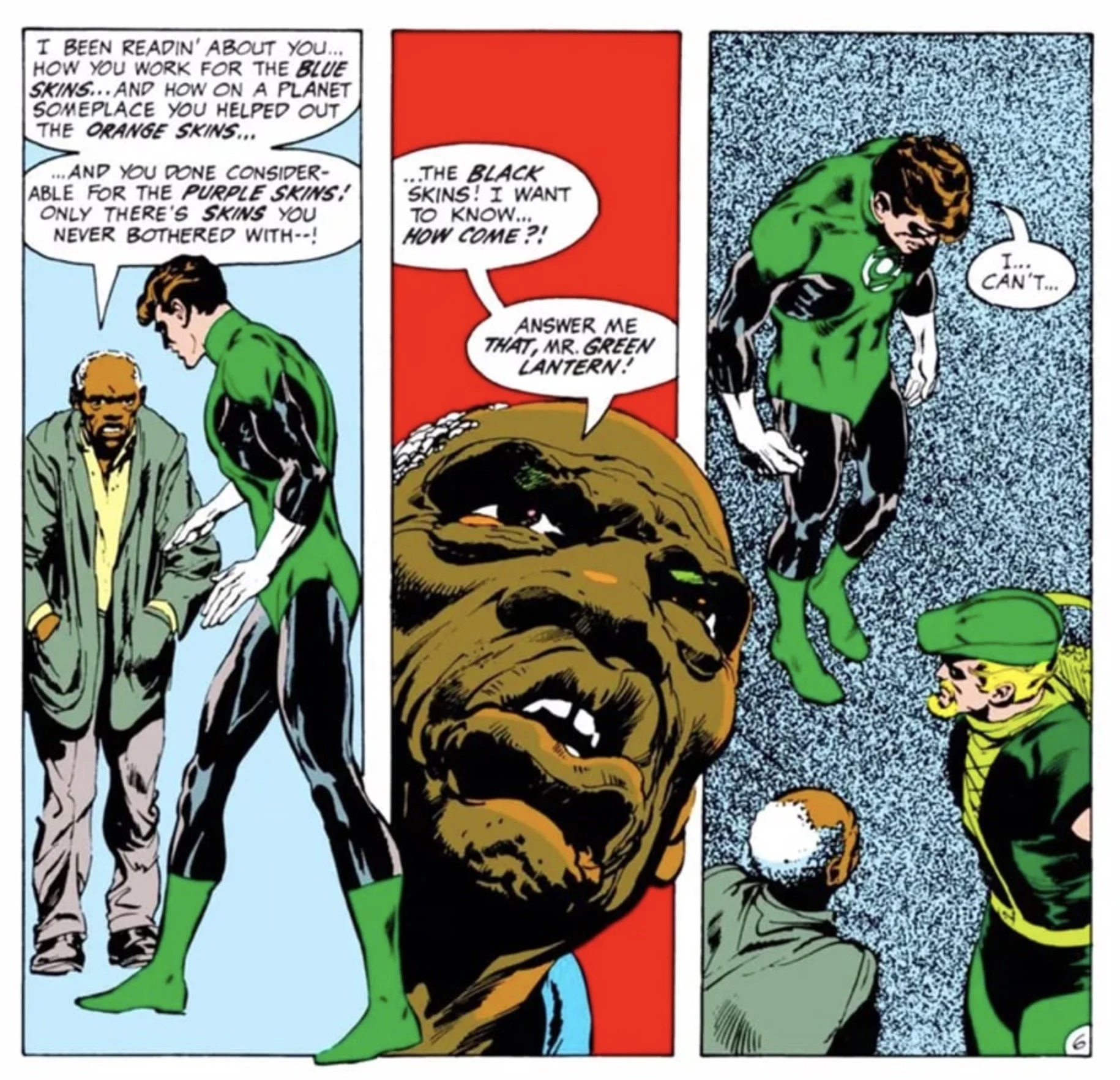
That claim comes with quite a bit of historical baggage. During the late 1960s and early 1970s, Dennis O’Neil and Neal Adams used Green Lantern/Green Arrow to confront social and political issues directly.
Hal was intentionally written as the more establishment-minded character, someone who could be disconnected from the problems happening around him.
Those stories weren't exactly subtle about his shortcomings. The Guardians of the Universe once criticized Hal after he said John had a “chip on his shoulder,” calling out his “petty bigotries.”
Hal also historically referred to his Inuit friend and sidekick Tom Kalmaku using the offensive nickname “Pieface.” The nickname was eventually abandoned and is now widely recognized as an ugly artifact of the period in which those comics were written.
Does that make modern Hal Jordan canonically racist? That's where Smith's argument becomes much harder to square with the character as he has existed for decades.
Hal and John are now regularly portrayed as friends, allies, fellow Green Lanterns, and equals. Using select stories from more than half a century ago to define Hal's current characterization ignores decades of comics that followed.
By the same standard, John calling Hal “whitey” in stories from that era would also need to permanently define him, which obviously doesn't reflect how either character is written today.
Old superhero comics are filled with dialogue, stereotypes, and cultural attitudes that haven't aged well. Sometimes those elements remain important pieces of a character's history. Other times they're examples of storytelling conventions that publishers and creators wisely left behind.
The more interesting question for Lanterns is what the series plans to do with all of this. Exploring how two men from very different backgrounds understand fear could make for compelling Green Lantern storytelling.
Turning Hal's selection into something primarily associated with racial privilege, however, changes the equation considerably, particularly when the Green Lantern mythology has traditionally been about confronting fear rather than simply being free of it.
With Hal's full origin still waiting to be explored, Lanterns has an opportunity to give this debate more context. Until then, calling Hal Jordan “canonically” racist based largely on material from a very different era of DC Comics feels like an oversimplification of a character who has changed considerably over the past 50-plus years.
Lanterns has certainly given Green Lantern fans plenty to argue about, and this conversation probably isn't cooling down anytime soon.