Review: Better Develop Your DUNGEONS & DRAGONS Game with New Workbooks
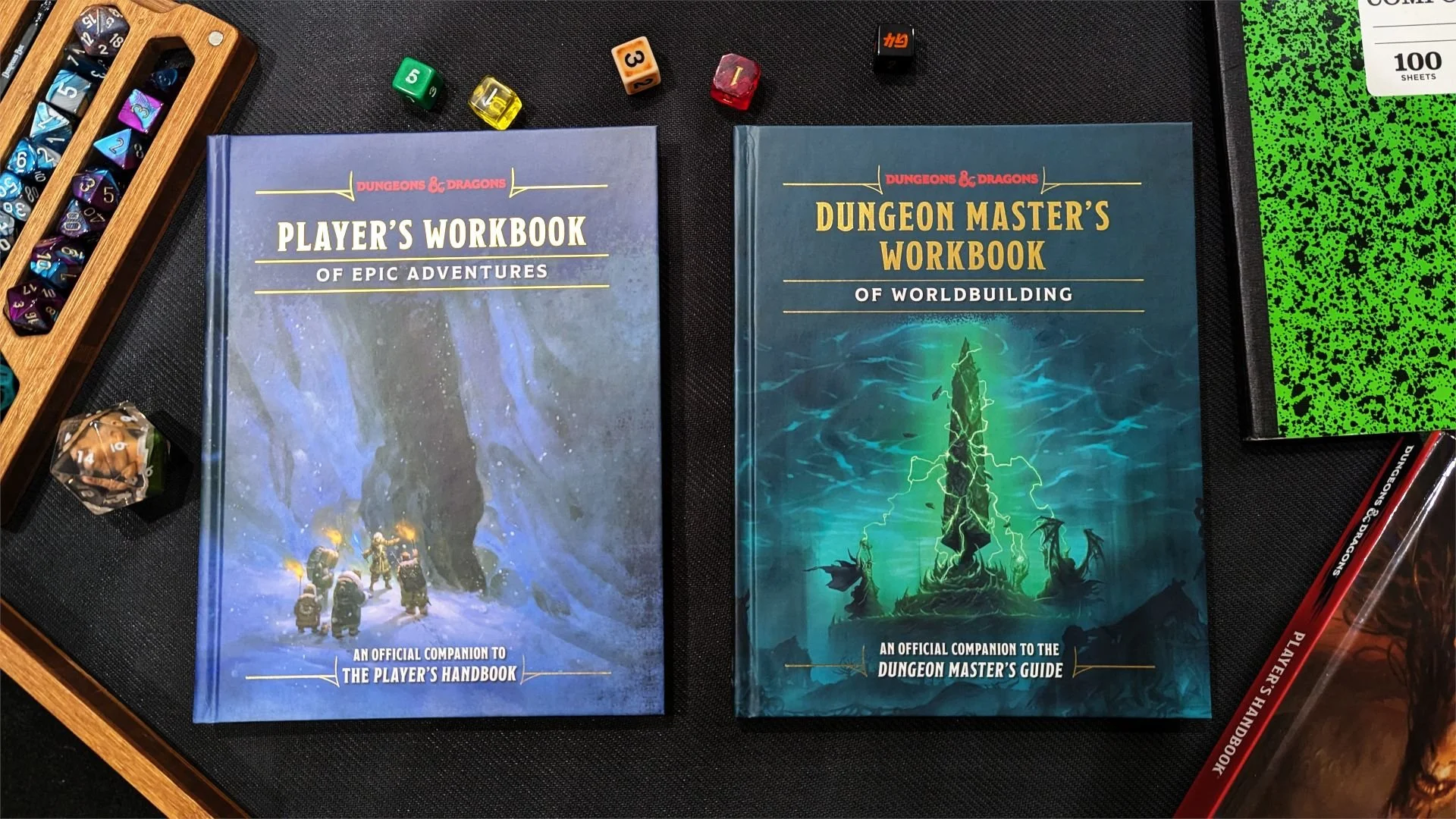
This month Dungeons & Dragons and Penguin Random House have released two official companion workbooks for fans of the tabletop roleplaying game to enjoy. The Player’s Workbook of Epic Adventures and Dungeon Master’s Workbook of Worldbuilding are both available now from your favorite retailers with an MSRP of $26.
Shoutout to the teams for supplying me with a copy of each for the purpose of this review, but all thoughts below are my own. These are technically two separate books, but they’re similar enough that I’m going to use one review for both of them.
As you might guess, the Player’s Workbook of Epic Adventures (PWEA) is a lovely hardcover book designed to help players create their next characters.
There are basic explanations of some game mechanics, but most of the book is full of prompts and exercises to help you get into a headspace to discover who your next character is going to be and what that means.
Meanwhile, the Dungeon Master’s Workbook of Worldbuilding (DMWW) does the exact same thing but to guide Dungeon Masters as they design and build the world of their campaigns. Shall we dive a little deeper?
Let’s start exploring the PWEA. I really appreciate that this book goes beyond simply some exercises to superficially determine your character’s class, subclass, and species. Those are definitely part of this book, but it also explores so much more.
For instance, it prompts you to describe how each one of your character’s attributes is exemplified by that character. An example is “How does your dexterity (or lack of it) inform your style of dress?” Oftentimes, I don’t think about things like this very much.
I just think about what looks cool without really considering how the stat might play a role in developing the character. Each stat will also give you a hypothetical situation to answer such as how you would cross a beam that is above sleeping enemies. Once again, it makes you think about how the stat is helping inform the character.
That’s just one small section of the workbook. There’s also sections about the character’s history (including a family tree), tattoos, alignment, etc. But there’s more valuable information in later sections. There are a few pages to help with your group’s session zero.
Some are towards the beginning where you define genre and setting and things like that and other parts are towards the end where your group discusses availability, sensitive topics, rules of the table, etc. There are also exercises you can complete to explore group dynamics and interactions for characters.
For many, this may seem trivial and silly that someone might want a book for all of this, but I think it’s a really nice tool that I want to use next time I go to start a new campaign.
Let’s take a little detour over to the DMWW now. This book starts with one of the greatest creative lessons one can get: learn to take from your inspirations. One of the first exercises included to help DMs is to list out aspects of some of your favorite pieces of media and then do some thought experiments with those aspects as you mix and match them.
Other useful tools include developing plot hooks, cosmology, what towns look like, your abilities to describe things, maps, and so much more. Once again, there are some pages to help note things about player preferences and some of those notes from session zero.
There are also tables to help with NPC generation, treasures, etc. There’s even a section that is designed to help you and your players get a better idea of whether you’d prefer theater of the mind or miniatures/tabletop play. There’s a lot in this book!
While I really like a lot about the PWEA and DMWW, I must admit that there is a glaring insensitivity: the format. While the hardcover is very nice and the artwork on it is immaculate, it’s not the best format (in my opinion) for a workbook. I think a paperback would be nicer for this purpose, but also, if you actually fill out the workbook as intended, you only get to use it once which is annoying to me.
I think having a hardcover book with the prompts would be nice if the actual workbook pages came in a packet of paper or as a digital access option. That way you could reuse the same hardcover book for several campaigns/characters since you’re not writing directly in it.
This single-use design is also frustrating when you look at the $26 price tag. If I play in multiple campaigns, it’s not really feasible for me to buy a new PWEA or DMWW for each one. Heck, if I’m a player and my character dies/retires and I need a new one, that could be $52 for one campaign.
This would be a much easier pill to swallow if the books came with access to digital files of the exercises. Those files don’t have to be fancy or colorful either. They could be fairly basic, black and white pages that don’t have the same artwork and such. Honestly, if purchase of these books came with access to digital files to use for filling out the prompts I would not mind the $26 price tag.
Overall, the PWEA and DMWW are fantastic (and gorgeous to look at) tools to help D&D players and DMs build their worlds and characters. Unfortunately, it’s designed to be a single-use product and is fairly expensive for that.
That said, if you have some notebooks or journals that you can pair with the book of your choice, I think you can get a lot of useful help from these books. Even if you don’t complete every exercise or prompt, there’s plenty of value in these.