Review: Grow Strategically Mirrored Gardens in EVENGLOW
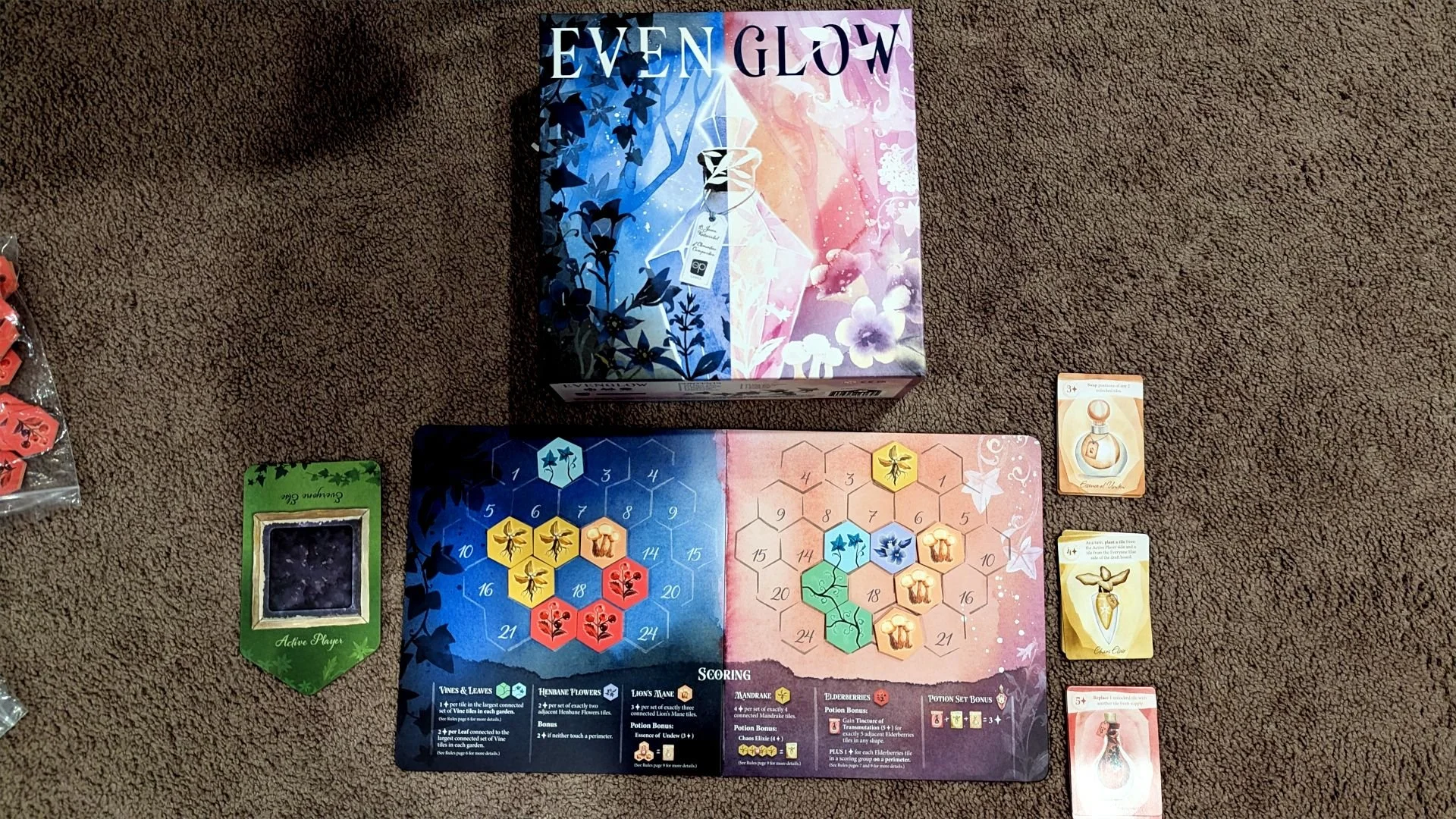
Evenglow is a new board game from Jason Katzwinkel and published by The Op Games. In the game, you and up to three other players will enjoy growing two gardens each in an attempt to score the most points. The team at The Op Games was kind enough to send me a copy to review, but all thoughts below are my own.
I quite enjoy Evenglow. I would say it’s a light strategy game that reminds me of games like Azul. You can play with up to four players, including a solo mode in case you can’t get anyone else to play. You’ll need (and want) to read the rules before playing, but most information that you’ll need during gameplay is included on each player’s board. Let’s dive into some more specifics though.
In Evenglow, each player is growing two gardens simultaneously: a night garden and a day garden. On every player’s turn, all players will obtain two plant tiles; one for each garden. Now, the real interesting thing is that the tiles must be planted in mirrored spots. Thankfully, every space on the board is numbered so it’s easy to identify which spaces are mirrored (if you place a tile in space 17 of your day garden, the other must be placed in space 17 of your night garden). It’s also important to note that you never have 100% choice of what plant tiles you obtain every turn.
What I like about the mirrored aspect is that it forces you to prioritize different strategies each turn. If you’re building up vines in one area and mandrakes in another but then you’re given both, which one will you prioritize?
Sometimes you luck out and the two plants you get are perfectly aligned with your current strategy, but a lot of the time only one of the plants you acquire on a turn will really fit into your plan. This may cause you to prioritize acquiring potions that allow you to move or completely swap out tiles or it could breed a new strategy that you hadn’t been working on that ends up giving you the points you need.
On their turn, a player draws a card with four plants (there are 6 types in total) in a 2x2 grid. The player can then rotate it however they want and put it on the draft board which is pointing at themselves. Then, the turn player gets the two plant tiles indicated closest to them while all other players get the other two plant tiles.
This is a very well done mixture of strategy and luck since you can’t completely choose the plants you get on your turn, but you get some say. In addition, this also gives you some agency in what tiles your opponents have access to which is another layer of strategy.
I want to mention that at the start of the game, after you determine play order, you draw one of four seed cards. This card will give each player two plant tiles and say which space they go in. I really like this design for starting because it gives you direction on turn one.
The game simply continues like this until you run out of cards to draw from. This usually means that you’ll have about one or two open spots on each garden in the end. A little warning though. Like similar games, it’s easy to lose track of how far into the game you actually are.
Many times when I played, we got down to the last 2-3 turns before any of us realized we really needed to figure out our last minute plans. That said, I’ve never had a bad time playing Evenglow and people often ended up faring better than they expected in the end.
Each type of plant has a unique scoring mechanism that will help guide your strategy. For example, you need three Lion’s Mane tiles connected (such as in a line) to score their points at the end of the game. In addition, three plant types have the potential to grant you a potion if you use the proper arrangement.
Using the example of the Lion’s Mane, if you arrange them in a triangle, then you will acquire an Essence of Undew in addition to the standard scoring at the end of the game. Each potion type has a unique ability (Essence of Undew allows you to swap two tiles on your board) plus additional points at the end of the game. Potions are almost always worth it if you can manage it.
One of the most important things to remember when playing Evenglow is that most of the plant types score in groups of set numbers and groups cannot touch. Remember that Lion’s Mane example? If you have more than three touching; you do not get to score any of the tiles in that group. This is especially tricky to remember at times because one type of plant (vines) wants to be grouped as much as possible to score big.
I want to take a moment to discuss the two variant ways to play Evenglow. One is dubbed “My First Gardens” and is played the exact same way, but without the potions and some bonus scoring conditions. I never tried this variant so I do not have many thoughts, but it would be a good way to introduce people who do not play boardgames very often or younger kids to the game.
The other variant is the solo mode titled “Play Against the Unseen.” You play the exact same way and are always the turn player, but now the plants that would usually go to the other players, are put on the special solo board. The game scores points based on how many of each plant type ends up on the solo board and at the end of the game, you compare your score to the one on the solo board to determine if you won or lost (you want the higher number).
One of the big selling points for Evenglow in my opinion is the aesthetics. Everything is well laid out and just pretty and calming to look at. If that’s not enough, the pieces feel very nice to handle. The cards are fairly standard, but the plant tiles are soft foam that feel nice to pick up and use.
The main problem I have with Evenglow is genuinely the poor design of the insert. It’s one of those barely folded pieces of pretty cardboard. Unfortunately, because of this “insert” the game doesn’t pack up very well. There’s very little space to put the 6 big bags full of the thick foam tiles, four player boards, the rulebook, the cards (two decks of different-sized cards by the way), and the turn player tile. This game is fantastic, but it’s irritating when designers/publishers do not think about how the game will fit back in the box.
If you want a casual strategy game, I would highly recommend Evenglow. It’s pretty, thematic, and in a weird way feels meditative. I am looking at designing my own insert for the game which is a shame because the cardboard “insert” is very pretty and I’ll be sad to lose it. However, it is a pain to neatly pack up as is which will cost the game a full point in this review. I still recommend it though.