Review: PEOPLE OF NOTE is Fun Despite Missing the Occasional Beat
Last month, Annapurna Interactive released People of Note by Iridium Studios. The team at Annapurna Interactive were kind enough to supply me with a Steam code for this review, but you can play the game now on Nintendo Switch 2, PC (Steam | Epic), PS5, and Xbox Series X|S. All thoughts below are my own after having completed the game.
Many months ago, I heard about People of Note and it intrigued me as it was billed as KPOP Demon Hunters meets Clair Obscur: Expedition 33. Those were both cultural behemoths from last year and Clair Obscur was even my personal game of the year.
Throw in my enjoyment of musical-esque games such as Stray Gods and I’m definitely down to check out People of Note. Please note that I will do my best to keep everything spoiler-free but there may be occasional light spoilers. If you’re sensitive to that and just want the score, scroll all the way to the bottom now.
In People of Note, you take on the role of Cadence, a pop star wannabe from the land of Chordia. You end up on a quest to create a band featuring characters from other nations (each one based on a different musical genre) in order to win a competition similar to American Idol or Eurovision and eventually you end up on a quest to save the world.
Throughout your adventures, you’ll notice themes surrounding loss, corruption, inclusivity and the power of togetherness, etc. In fact, the most forefront message is all about the power of coming together from different backgrounds to create something greater than the sum of its parts.
In the game this is played out more as being open to experiencing and experimenting with other musical genres (something that people in the real world should consider), but it definitely applies to more real world situations such as race, religion, sexual identity, etc.
In terms of storytelling, People of Note does a good job. There’s nothing surprising or revolutionary about the story itself. As you go through the game, it’s fairly easy to predict what’s going to happen next, but that doesn’t make a story bad. I never felt lost or confused, there weren’t any glaring plot holes, and everything works in-universe.
That said, there is a problem. The third act of the game felt a little dragged out. There’s a point when you’re in a combat gauntlet, but the only difficult fight is the last one and so it doesn’t feel like a challenge, but rather a time sink.
Likewise, there’s a point that has you solving 3 long puzzles which once again just feels like a time sink. The final act of a show is usually the shortest because you want to maintain the momentum you’ve established. In People of Note, the third act feels like it loses its momentum pretty quickly.
Part of this is because it wants to give you the opportunity to check in with key NPCs which I can understand from a gamer’s perspective, but then having aspects that feel more like time sinks really disappointed me.
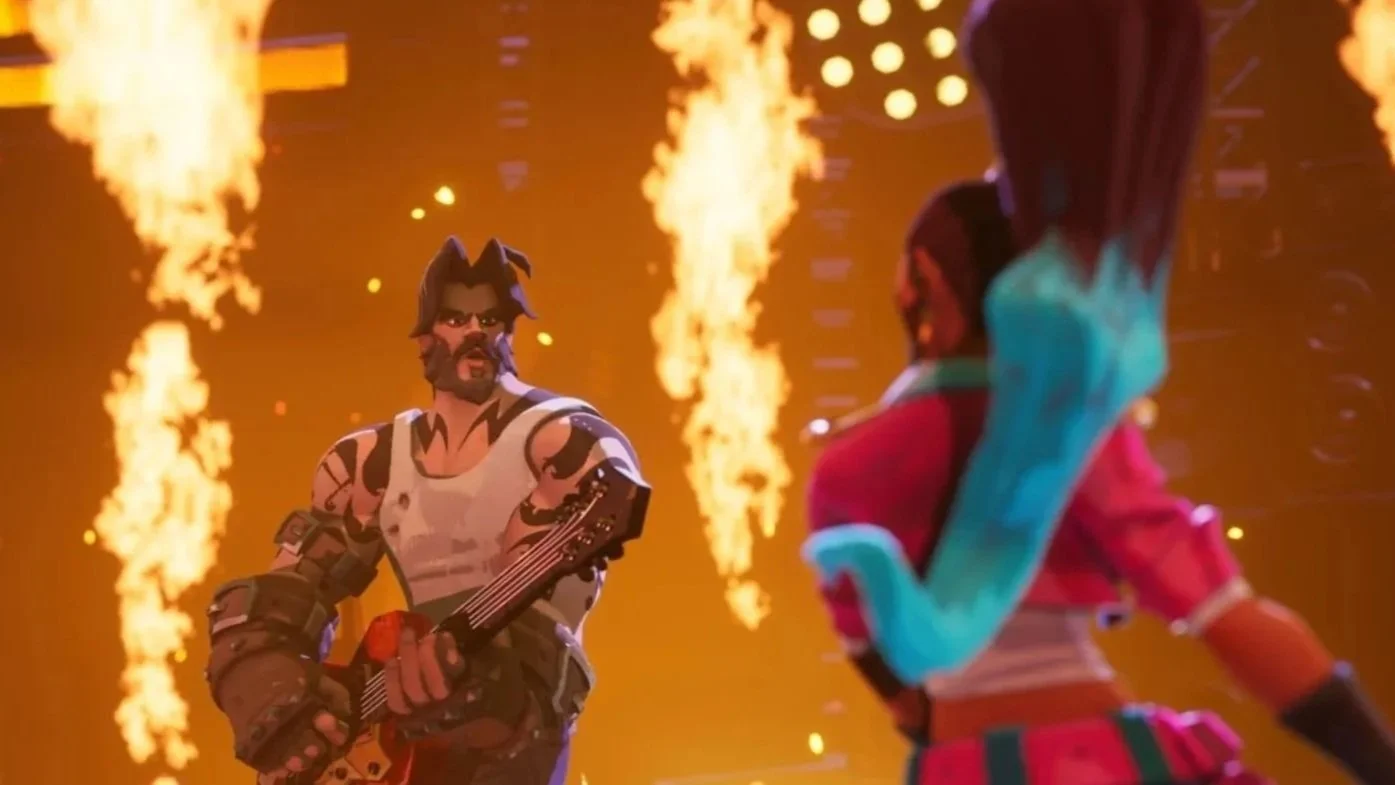
The most fun aspect of storytelling in People of Note is the musical numbers. Every now and then, the story will hit an important beat and trigger a 2-4 minute long fully-animated musical number.
Jason Wishnov of Iridium Studios has mentioned that for several months, they had to convert part of the game studio into an animation studio to make these videos and quite frankly, they’re a lot of fun. Wishnov shared in an interview with my favorite gaming podcast, Get Played, that his inspiration for People of Note was Hamilton and these animated musical numbers do a good job of creating that musical feel.
I personally would have expected 1 or 2 additional numbers at some key points, but alas it wasn’t in the cards I guess.
There are a lot of points to discuss in regards to People of Note’s gameplay. It is a turn-based RPG and so a lot of the time you’ll be running around in one of the nations of Note or you’ll be in combat. Combat essentially has two parts to each round: your turn and your opponent’s turn.
During your turn, you will have a set number of actions that your team can make and each character must take an action before any can take a second action. Any offensive attack or heal action that you take requires rhythm-based button presses in order to determine its potency.
The more on-beat you are, the stronger the effect. The nice thing is that when you go to select an action, it will give you the range of how effective the action will be.
This brings me to my first real bummer about People of Note: the combat is not very engaging. Sure, you have to time your button presses, but when the enemies go, you can just take a little nap or go get a snack. This is one of my biggest pain points with most turn-based RPGs in general.
It often feels like you’re only playing for half the game. I really wish that there had been some mechanic (once again, could make it rhythm-based) to let you dodge or guard even some of the damage to help keep me engaged.
It also means that as you get further into the game, the only ways to add challenge are by having the enemies have more health (damage sponges), deal more damage, or both. I personally am not a huge fan of this approach.
However, to their credit, People of Note does not want a bunch of players “turtling” (using lots of defense and health to eventually chip away at the enemy’s health) their way through the game. To combat this, boss fights utilize the Crescendo mechanic.
Every few turns, the Crescendo meter rises and the enemies become stronger. They deal more damage and utilize new attacks. This is nice even if it makes some fights frustrating to get through at times.
Like any good RPG, the party has equipment that impacts their stats and abilities. In People of Note, there are 3 equipment slots: weapon, clothes, accessory. Your weapon affects your Offense stat and your Songstones (the special abilities usable by that character in battle).
Your clothes impact your Defense stat. And the accessory can have a variety of effects including boosting different stats, adjusting how you recover BP (the mana system), etc. It’s all very simple and I was honestly hoping for a little bit more to it, but I’ll take overly simple over overly complicated any day.
As previously mentioned, each weapon affects your character abilities. Each one has a different Songstone map which determines how many Songstones you can have as well as how many (if any) Remix stones point to different Songstones.
This is something that you will want to make sure you are paying attention to as you play. I would get a new weapon, forget to adjust the Songstones, and find that my strategy got completely out of whack because of this. It’s a simple thing, but one that I kept forgetting. I think it would be nice if it prompted you to adjust your Songstones when equipping a new weapon.
Moving away from the combat aspect of People of Note, you do have to traverse the world of Note. You talk with NPCs, find items, and engage with platforming puzzles.
To help you with these, you’ll gather abilities throughout the game to help you perform actions such as moving parts of a giant recorder or adjusting the pressure of a geyser. Most of these puzzles are not too complicated once you remember how some of the powers work and most people should be able to complete them after some time thinking and analyzing.
That said, while solving these puzzles, there were times when trying to go from one platform to another felt like it took a while to find just the right spot to trigger the jump. In addition, there were multiple times I got worried that Cadence got stuck and there was one time in the Choral Reefs when she did get stuck and I had to go back a save file.
It probably cost me about 15-20 minutes, which isn’t the worst, but it’s still frustrating and annoying when it’s simply due to hitting a bad pixel or two. I know the team has been fixing many bugs like this, so its inclusion is mostly a warning to make sure you’re frequently saving.
Let’s talk visuals for a moment. People of Note is not a graphic marvel. It’s not hyper realistic. From an art direction, it is very cartoonish with that almost clay-like 3D design for the most part. Honestly, I prefer the 2D look used in most conversations. It has more of a sketchbook feel that I just find appealing.
Synthia in particular I liked more in the 2D design because her goggles were opaque and felt more sci-fi and EDM with digital eyes that emoted. It just worked nicer in my opinion. The nice thing is that this means you don’t need a very powerful machine to run the game.
I played a lot of it on my Steam Deck and (per Wishnov’s recommendation) I maintained around 60fps on Medium settings throughout the game. On my desktop, I easily maintained 60fps on Ultra settings.
For audio, everything sounds fine. It’s well written, well produced, and well done. The sheer number of tracks made is astounding because each battle theme has at least 5 versions: the original and then one for each musical style. I do like the variety.
The one audio thing that I’m not the biggest fan of is the timing for attacks. Each attack that has a rhythm component has a set musical sting that you have to match. This is nice because you don’t have to learn button presses for 5 versions of the same cue, but the music and sounds played rarely, if ever, match the music of the battle and so it really takes you out of the moment.
You can be in a tough battle in Lumina (the EDM city), getting really into it, and you’ll hear the same short guitar riff when your rocker band mate goes to use his attack that you heard in any other battle. It stands out like a sore thumb. The advantage of this is that it gives you that audio cue to remind you exactly what attack you’re using, but at times it feels a little jarring.
A more general pain point for me was that there were times when the UI got in the way. Especially later in the game, I might be in combat and I would try to check the health or something of a character/enemy on the right side of the screen, but the UI would be blocking it and I couldn’t see what I was looking for.
Let’s end with some more general positives. The vibe and overall feel of the game is very fun. It’s extremely punny and so many characters, enemies, etc. are some kind of musical pun.
For example, one of the collectibles is Weird Owl Feathers which you obtain by correctly answering trivia questions and attacking the correct Weird Owl. During which, instead of normal combat music, you’ll be treated to some polka. Also, there are accorgians throughout the world of Note and you can pet them! These are fun!
In addition, during the credits, players are treated to a music video of Wishnov and a band playing a song about the development team. It’s a really fun way to end the game and I appreciate the acknowledgement of just about everyone who worked on the game.
At the end of the day, People of Note is a fun and very bright musical turn-based RPG. I believe that the team at Iridium did a really good job with it. I enjoyed the game but it definitely could have been refined a bit more and there’s no draw to replay it.
At the end of the day I’d give People of Note a 7.5/10, but here at GeekTyrant, we don’t believe in decimal scores. Sadly, due to the disappointing pacing of the third act I feel I must ultimately round down on this one.