Review: THE ULTIMATE RPG VILLAIN BACKSTORY GUIDE is a Must Have Reference for GMs and Creatives
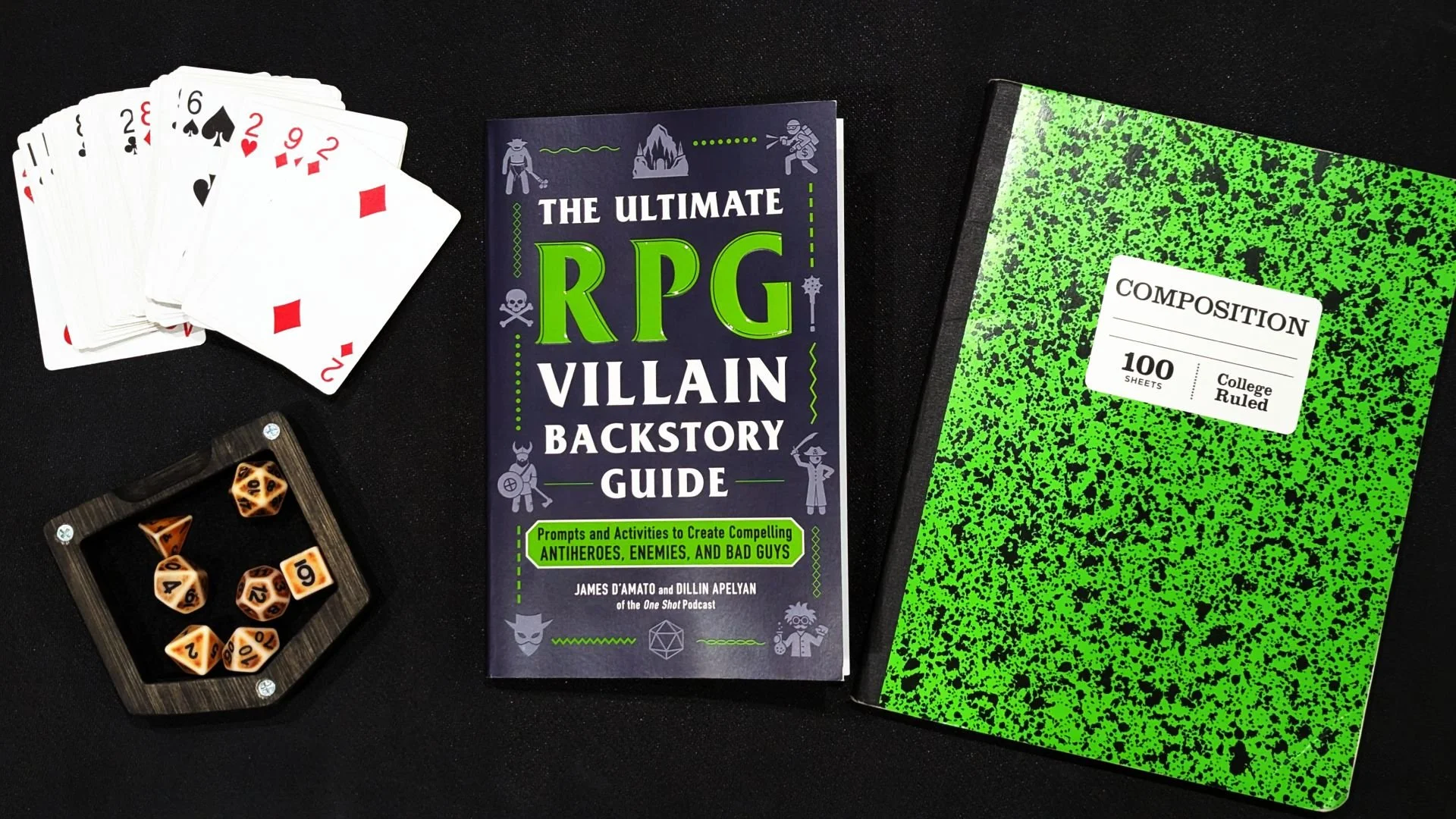
Last month, Adams Media published The Ultimate RPG Villain Backstory Guide: Prompts and Activities to Create Compelling Antiheroes, Enemies, and Bad Guys by James D’Amato and Dillin Apelyan. This is the third entry in the Ultimate Role Playing Game Series. The team was kind enough to send me a copy to review, but all thoughts below are my own.
You can purchase your own copy from your favorite book retailers with an MSRP of $16. Also, as you use the book, you’ll want to have some tool you can use to make notes (i.e., laptop with word processor, pen and paper, etc.).
What is The Ultimate RPG Villain Backstory Guide? In short, it’s a workbook full of prompts and tools to aid you in creating villains for your tabletop RPGs. While primarily meant for game masters (GMs), the book is also helpful for any players looking to create evil or villainous playable characters.
Please note, this book is system agnostic. It does not provide stats nor mechanics so you can use it with literally any RPG. Heck, I think this could even be used by fiction authors, scriptwriters, and video game writers. In short, if you need to make a villain for your creative work, The Ultimate RPG Villain Backstory Guide could be helpful in all honesty.
Much of the core perspective in this book when creating villains comes from using character values instead of character morality. This simple mindset adjustment I think is very helpful for less experienced GMs in particular as they try to customize or even create their own villains for their adventuring party to encounter.
Good villains, even the chaotic evil ones, have their own set of rules which may not align with their morality, but they do align with their values.
The first time that you go to use The Ultimate RPG Villain Backstory Guide, I would say you must read the introduction and first chapter. That sounds like a no-brainer, but I also know many people will want to just skip ahead and I want to really highlight that you shouldn’t do that your first time.
I would also recommend reviewing the second chapter in full at least every other time that you go to use this book. When you don’t read the full chapter, you will at least want to revisit the Villain Creation Exercises starting on page 25.
From there, you’ll only need one additional chapter based on the type of villain you want to create, Outlaw, Leader, Believer, Opulent, or Supernatural. At the very beginning of each chapter, it will give you popular archetypes within each type as well as examples to help you understand which villains are which.
As you create your villain, each type of villain will have unique accent features for them such as a scar for an outlaw or a believer’s friendly face. You’ll also find questions with multiple choice answers often followed by some prompts that will require at least a full sentence.
An example for the leader is a set of questions to define their rival. You are given some choices to select from to help define the rival, but then a couple of prompts such as defining something in your rival that you see as a weakness as well as something that you respect or see as a strength.
As you go through the process, you’ll even find some mini-games to help you create your villain. For example, the opulent has you build a tower out of dice to help tell how the character affects the economy of the world and each die you add represents an economic bubble growing until it bursts and then you find the results. This is just one example, too.
Other ways that decisions are made include a 5-point rating scale approach but each question has to have a unique value. For example, the outlaw uses this technique (called Priority in the book) when going to develop the villain’s competition.
They must pick a different value between 1-5 for their competition’s grit, manifesto, reputation, history, and obsession. Depending on the value given, there is a different description to help flesh out their personal world and world view.
I think it should be clear that this book is not meant to be used to quickly or even fully pump out villains like a Monster-Matic from Mighty Morphin Power Rangers. Creating good villains takes a lot of work and The Ultimate RPG Villain Backstory Guide is here to help get creative juices flowing. Yes, you’ll end up with at least a skeletal outline for your villain that can be helpful for the first encounter with the adventuring party, but you’ll likely want to put some additional thought between encounters.
There is one thought I have that is not super positive. The Ultimate RPG Villain Backstory Guide is more or less a workbook to get you started on the track of creating amazing villains for your RPGs. It even has spaces where you can write-in basic answers or mark things.
However, you probably don’t want to do this as a reader since you’ll want to reuse the book for multitudes of evil doers. This is an area where a digital copy might outshine a physical one since you might be able to print or screenshot pages to then digitally mark up.
I wish there was some way to download packets for each villain type to make writing a bit less repetitive. I do understand that the logistics of actually making that work while not just putting it out for anyone to use at no cost is probably fairly complicated.
It is easy to see that D’Amato and Apelyan have put a lot of thought and effort into The Ultimate RPG Villain Backstory Guide. If you are a GM or have a group that wants to play a villainous campaign, I would strongly recommend utilizing this book.
Depending on your creative levels on a given day, it might be helpful to fully go through the process or it might be nice just to take a couple of ideas from this book. Regardless, this is a book I would strongly recommend for any GM or creator in the RPG space to have on hand.