SPIDER-MAN: BRAND NEW DAY VFX Boss Says Finishing 445 Shots in One Week May Have Been a Big Mistake
Marvel and Sony’s Spider-Man: Brand New Day was a massive undertaking when it came to visual effects, and the team behind the movie had an absolutely crazy schedule to get everything finished. We're talking nearly 2,000 VFX shots, just 24 weeks of post-production, and a final stretch that pushed the artists to their limits.
During a presentation at the View Conference in Turin, overall VFX supervisor Jerome Chen shared some interesting details about bringing the movie to life, including the redesign of Mark Ruffalo’s Hulk, the challenges of turning British locations into New York City, and the ridiculous number of effects shots completed in the final weeks.
“In one week, we did about 445 shots,” Chen revealed. To put that into perspective, his first movie as a VFX supervisor back in 1999 featured 450 effects shots in total, and that project took two years to finish.
Things got especially hectic toward the end of production, with roughly 75% of the film’s visual effects delivered during the final six weeks. That's an enormous amount of work to complete in such a short window, especially for a movie with so many visual effects.
Chen explained that work on Spider-Man: Brand New Day began with a scouting trip to New York in December 2024, before he even had a finished script.
Director Destin Daniel Cretton wanted to bring Spider-Man back to his street-level roots, making New York City an important part of the story. The challenge was that most of the movie would actually be filmed in the U.K., with Pinewood Studios, London, and Glasgow standing in for the Big Apple.
Production designer Charles Wood helped establish the film's visual style through concept art, favoring a more restrained color palette with brighter, saturated colors reserved for important emotional moments.
To make the British locations feel like New York, Chen's team kept as much of the practical street-level photography as possible while digitally replacing or expanding the buildings and environments above it.
“We just found basically a recipe of a half dozen or so things that tell you that it’s New York,” Chen explained. Those details included hanging traffic lights, scaffolding, rooftop water towers, and properly placed power lines. Even the yellow curb markings commonly found on British streets had to be digitally removed.
Some of the biggest challenges came from surprisingly simple descriptions in the screenplay. One sequence involving Spider-Man and a tank was originally just a few words on the page, but it eventually became 11 visual effects shots spanning approximately 52 seconds.
Rather than spending valuable time creating elaborate digital previews, the team used physical tabletop models to figure out how the tank should smash through a building.
They also came up with a clever technique for capturing Tom Holland’s performance inside Spider-Man's mask. A small camera rig attached to a helmet filmed Holland's face up close, and the effects team later added a blurry red shape to give the impression that viewers were seeing the inside of his mask.
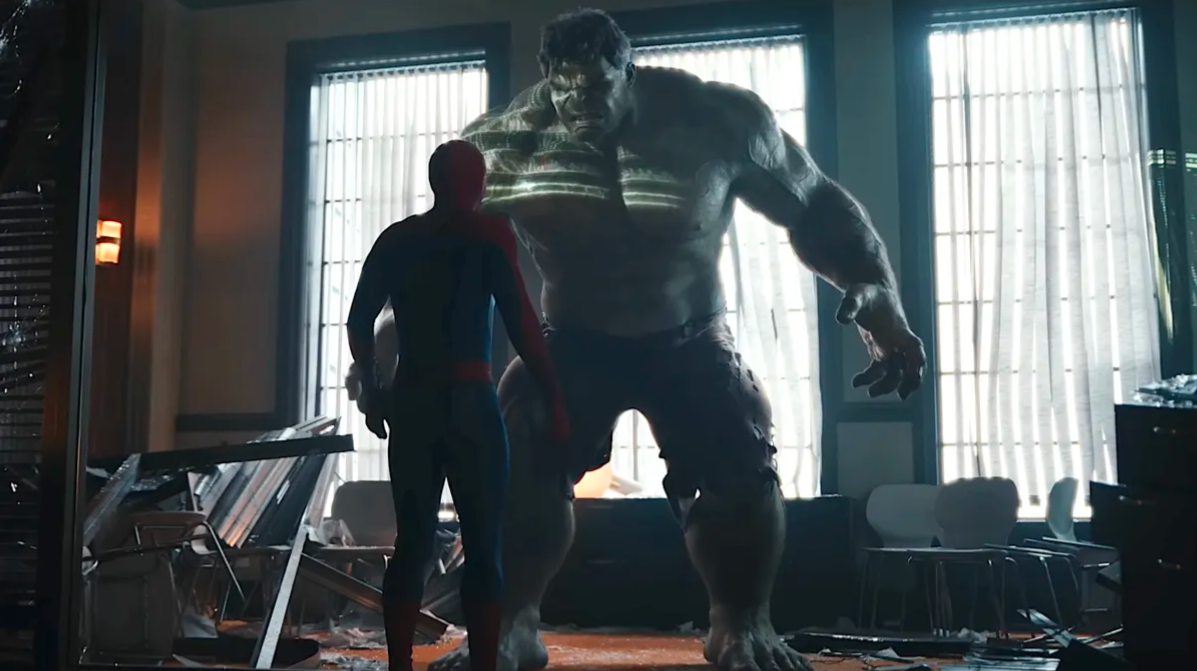
“Sometimes the easiest tricks are the most effective,” Chen said. One of the more interesting parts of Chen's presentation involved Hulk, who appears in Brand New Day in a more savage state while under telepathic control.
This was Chen's first time working with the character, and he wanted Hulk's appearance to reflect his more aggressive condition. That meant revisiting everything from his muscular structure and body proportions to his hair, skin, hands, and feet.
Chen even consulted Marvel Studios president Kevin Feige about how Hulk's design had changed throughout his various MCU appearances.
The team ultimately gave Hulk longer arms, reduced his body fat, adjusted his muscle definition, and made his hair grayer. They also reconsidered the proportions of his hands and feet to give him a more intimidating physical presence.
The amount of detail that went into the redesign even extended to Hulk's toenails.“I realized that nobody had ever looked closely at Hulk’s toenails before,” Chen joked. “That was something that we had to do.”
Apparently, some previous versions had toenails that looked unnaturally green, so the artists worked to make them more convincing. They also paid close attention to how Hulk's skin reacted to different lighting conditions.
One particularly cool detail involves Hulk's eyes. While he's under telepathic control, his eyes are green, but they subtly change to brown when he begins regaining his humanity.
To help the actors and camera operators understand Hulk's enormous size, the production also used full-scale, 10-foot stand-ins on set. Even his pants required additional visual effects attention.
Another challenging sequence involved Jean Grey and a climactic wave of psychic energy. Chen originally wanted to avoid the familiar rainbow-like chromatic effects often used to represent superpowers in movies.
He hoped to find something different, but with only five weeks left in post-production, he decided that the more recognizable visual approach worked better than an effect that looked too electronic.
He wasn't entirely happy with the result. “I thought it was the weakest part of the film,” he admitted. “I wish we had come up with something better.”
Chen also addressed something audiences often overlook when criticizing visual effects. When a CGI shot doesn't look convincing, the problem usually isn't a lack of talent. More often, the artists simply weren't given enough time to finish their work.
“If you go to a movie and you see that there’s a visual effects shot that doesn’t look that good, it’s not because there are bad artists on it,” he said. “You can tell they just ran out of time.”
These productions involve hundreds of artists working under enormous pressure, and sometimes the deadlines don't leave enough room to get everything exactly right.
Chen explained that one way to deal with the constant stream of decisions is to evaluate visual effects shots as part of their complete sequences rather than getting caught up in perfecting individual frames.
While the team successfully completed Spider-Man: Brand New Day in just 24 weeks, Chen admitted that pulling it off might have created an unfortunate precedent for future productions.
“We may have done ourselves a disfavor by actually finishing this movie in 24 weeks because once again we’ve proven that it can be done on time.”
Ironically, after thousands of complicated effects shots involving superhero battles, city environments, and a redesigned Hulk, the very last visual effects fix was something hilariously ordinary.
During a final review, someone noticed a sweat stain underneath Spider-Man's arm. “You can’t have superheroes sweating into their suit,” Chen recalled.
With the major VFX vendors already finished, a small team at Marvel's Burbank offices handled the correction themselves. It took approximately 47 minutes to remove the stain, finish the shot, and deliver it.
That was it. After months of intense work, Chen finally left the studio through a nearly empty parking garage, with the movie officially finished.
It's pretty crazy to think about how much work goes into making a Marvel movie, especially when even something as simple as Spider-Man's armpit can become a last-minute visual effects assignment.
What stands out most about Chen's comments is just how much these artists are expected to accomplish in such a short amount of time. Finishing 445 VFX shots in a single week is impressive, but it's also a reminder of the immense pressure these teams face.
Hopefully, Marvel and Sony take the right lesson from this production. Just because a talented team can pull off something this demanding doesn't mean every future superhero movie should have to operate on the same schedule.
Source: Variety