THE ANGEL Brings Chilling Mormon Folklore to Life with Doug Jones in a Haunting Short Film
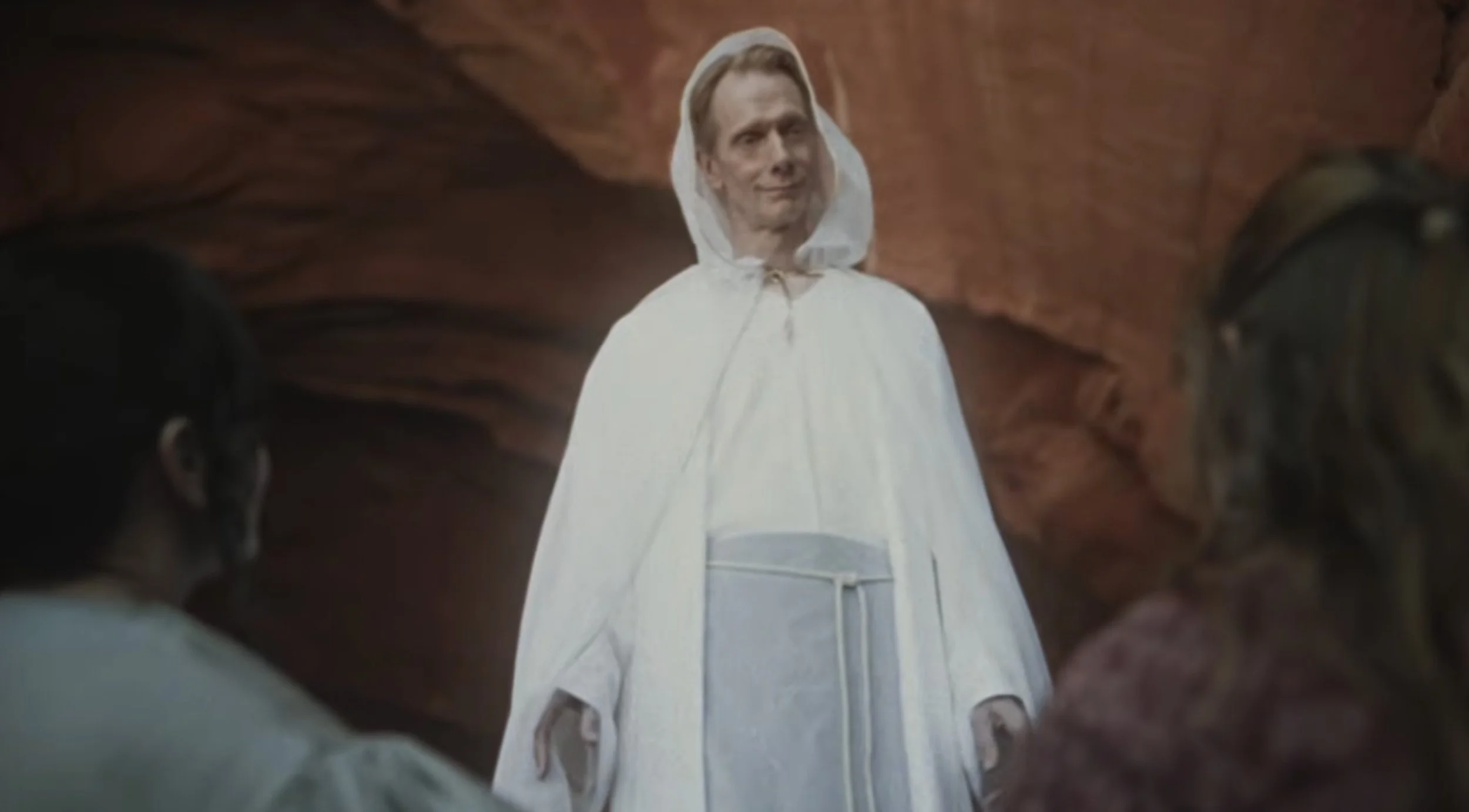
If you’re into atmospheric horror that digs into strange, lesser-seen corners of history, The Angel is one you’ll want to check out.
This short film drops viewers into a tense, isolated world pulled straight from 19th-century Southern Utah, blending religious folklore with something far more unsettling.
It’s eerie, thoughtful, and features a performance from Doug Jones that’s completely different from what you might expect.
Set in 1881, the story centers on a polygamous family trying to survive in a harsh, confined existence. A husband and his two wives live in a cramped cabin surrounded by the stark, blood-red landscape of Southern Utah.
Life is already strained, but things take a dark turn when a mysterious angel enters their world. What follows isn’t comforting or divine in the traditional sense. It’s something far more ambiguous and unsettling.
Directors Barrett Burgin and Jessica Burgin leaned deep into early Mormon folklore to shape the film’s tone and mythology, and you can feel that authenticity. They explain exactly what they were going for:
“Our film draws on the mystic folk doctrines of early Mormon settlers to evoke a cosmology that has rarely, if ever, been depicted on screen, brought to life by the incomparable Doug Jones.
“We approached the material with rigorous historical care, aiming to fill every frame with authentic detail while revealing the more obscure, unsettling spiritual traditions that exist on the margins of this religious history.”
That commitment to authenticity really sets The Angel apart. It isn’t just telling a scary story. It’s pulling from real beliefs and forgotten teachings, which gives everything a heavier, more unsettling weight.
They double down on that idea, saying: “Horror is at its best when it grants access to a new world. The Angel draws from the mystic folk doctrines and experiences of early Mormon settlers to conjure a demonology never before portrayed on screen, brought chillingly to life by the incomparable Doug Jones.”
This film opens a door into something unfamiliar and lets the audience sit in that discomfort. The filmmakers also bring a personal connection to the material:
“Many films and series today attempt to capture the distinct intrigue of Mormonism. But as adherents and inheritors of that tradition, we are culturally qualified and uniquely equipped to represent its deepest esoterica. Rooted in rich historical detail, our folktale opens a sealed door and extends you a guiding hand.”
One of the coolest behind-the-scenes stories is how they actually got Doug Jones involved: “It was literally a miracle: We were at FilmQuest with a feature script and decided to make a proof of concept.
“Doug Jones was there as a guest surrounded by people trying to get him in their projects. Producer (J Celene Anderson) told one of the directors (Barrett Burgin) that Doug looked exactly like Barrett had described the Angel character, even down to “sandy colored hair”, which was an important element of the actual historical folklore for this character.
“Celene encouraged Barrett to approach Doug to play the Angel, and pointed out that there was nothing to lose. Weirdly, Jonathan Martin, one of FilmQuest’s festival directors and a friend of Barrett’s, stopped Barrett and gave him a pro-tip if he was going to talk to Doug Jones. ‘Dougie had always wanted to play an angel.’
“Jonathan didn’t know anything about Barrett’s film or the characters, or even the setting! With newfound confidence, Barrett approached Doug and pitched him on the film. Doug said ‘you’re not going to believe this, but I’ve always wanted to play an angel!’
“He also really appreciated that Barrett was approaching the historical subject matter seriously, and was intrigued. And from there they got Doug.”
That story makes the project feel a little destined. They also shared some real-world advice that came out of that experience:
“We also got a distribution deal on ALTER from premiering at FilmQuest a year later. Go to FESTIVALS and NETWORK! They lead to the next project”
“Moral of the story: sometimes you need a miracle. But also, we NEVER would have gotten Doug Jones if we hadn’t approached him. That’s why it’s important to be at film festivals, to talk to people, to learn how to pitch, and to share your ideas. If we hadn’t approached him the answer would have already been no.”
As for Jones’ performance, this isn’t the heavily costumed, creature-heavy work he’s known for. The directors wanted something more cosmic and ambiguous:
“This angel is ancient, has been around since the beginning, and in some ways embodies an idea even more than a person. We almost wanted him to think of it as cosmic, like this supernatural being might not even be what he appears to be at all, angelic or not, and is simply taking the form of these Mormon women’s most deeply held beliefs and fears.”
They even tied his look to obscure historical details: “We wanted to cast him in part for his ‘sandy colored hair’ based on an obscure church history story, where Joseph Smith taught that if an angel had sandy colored hair, this was one of the signs that he could be known by, as to whether he was a true or false angel.”
And for fans of Jones, this might be one of the most interesting aspects of the film. You actually get to see him fully perform without being buried under layers of prosthetics:
“One of the factors that excited Doug about The Angel was getting to show his face and use his voice. Doug is known for his creature and character work, and his talent is often shown in his work as a contortionist, hidden behind prosthetics.
“However, we were grateful to get to show what a gifted actor he still is without any of that. Doug was absolutely incredible about taking notes, remembering all the background and context we gave him, and filling the character and story with his own interpretations and beliefs.
“As a person of faith himself, he said that while he wasn’t totally sure what to make of the specifics of what these women believed, especially polygamy, he knew for sure how to interpret his own angelic character, as he knew what an angel of God would or would not ask of these people if he were true. “
There’s also a ton of layered symbolism baked into the costume design that hints at the angel’s true nature:
“There are some interesting elements to Doug’s costume in the film, which was custom made by costume designer Iffer Mitchell. His blue-grey apron references an old Latter-day Saint tradition that a certain character wears emblematic clothing to signify power or priesthood.
“There are symbols on the apron, such as two pillars, a star, and a snake. While even many contemporary members of the church might not recognize this, the pioneer women certainly could have. He also wears a white sash with what looks like a snake skin pattern. In this way, there are many little hidden indicators about who this character might be. “
“The same is true of his character appearing over the water, or offering his hand, or calling them daughters of Eve and asking them if they know who he is. All of these are deeply coded Mormon lore that a Latter-day Saint would have a much more visceral reaction to.”
All of those details come together to create something that feels layered and thought provoking. It’s not just about what’s happening on the surface, it’s about what it might mean underneath.
The Angel is a seriously well-crafted short film that’s worth your time, especially if you’re into horror that leans into history and mythology. It’s unsettling, unique, and anchored by a performance from Doug Jones that shows a whole different side of what he can do.
You can watch the short film below along with the trailer: